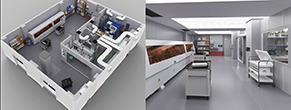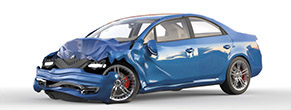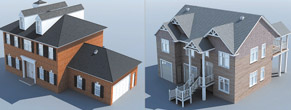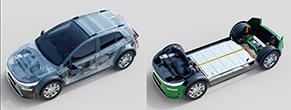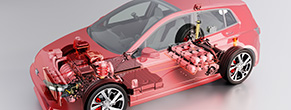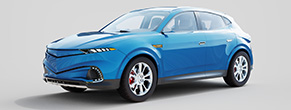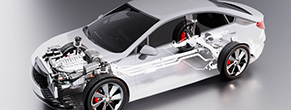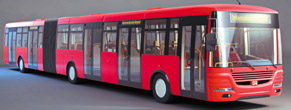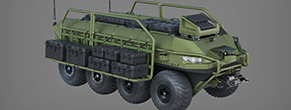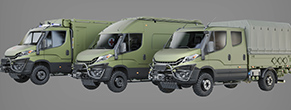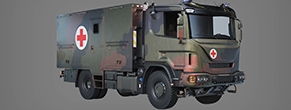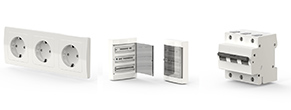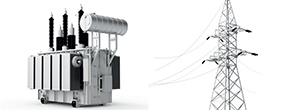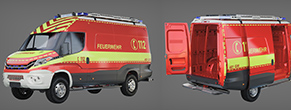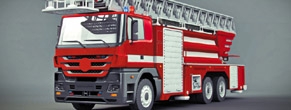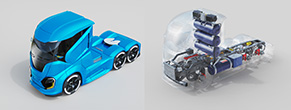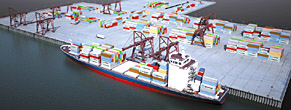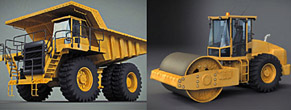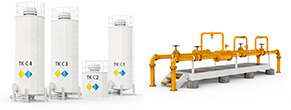
DOSCH DESIGN is consistently expanding its portfolio with high-quality 3D assets in the future-proof OpenUSD (Universal Scene Description) and USDZ formats. This strategic focus supports companies in realizing complex digital twin projects and developing the industrial metaverse. Our models are optimized for direct use in powerful ecosystems such as NVIDIA Omniverse and Siemens Xcelerator, bridging the gap between design, engineering and simulation.
OpenUSD (Universal Scene Description) is an open, extensible framework, originally developed by Pixar, for describing, composing and exchanging complex 3D scenes. Unlike a simple mesh format, it carries geometry, materials, hierarchy, variants and metadata in one consistent structure. That makes it the de facto backbone for digital twins and the industrial metaverse: a single, reliable description of an asset that every tool in the pipeline can read the same way. USDZ is its compact, single-file variant, optimized for mobile devices and augmented reality.
A digital twin needs more than shape. For an asset to be truly simulated in NVIDIA Omniverse or NVIDIA Isaac Sim, it must be SimReady - meaning geometry plus physical properties (collision bodies, mass, material behavior) plus semantic metadata and labels. This is exactly the value step we offer: on request we prepare DOSCH USD assets - or your own models - to be SimReady, so they work in your simulation and training environment with no rework.
Data interoperability is a key factor in Industry 4.0. DOSCH DESIGN USD models act as standardized building blocks that can be implemented in Siemens Teamcenter X, Siemens Process Simulate or NVIDIA Isaac Sim without time-consuming conversion. By using the USD format as a single source of truth, we enable seamless data exchange between various DCC (Digital Content Creation) tools and industrial planning applications. This significantly accelerates time-to-market and reduces potential errors when importing complex geometries.
Do you have your own CAD or engineering data? We convert it into standardized, cleaned-up USD and - on request - SimReady assets: reduced, clean topology instead of heavy CAD tessellation, consistent materials, correct units and a structure that works immediately in Omniverse and Siemens Xcelerator. This combines our role as a 3D agency with standardized products - something pure asset shops cannot offer. More about the CAD visualization service ->
The OpenUSD format offers far more than just 3D geometry. It enables non-destructive workflows through intelligent layering and referencing:
In addition to the heavyweights of industrial simulation, we also provide assets in the compact USDZ format. This guarantees the availability of your 3D data on mobile devices and in augmented reality (AR), for example via Apple ARKit. Whether for virtual factory tours, maintenance manuals or presentations, DOSCH DESIGN provides the universal data foundation for every touchpoint in the digital product lifecycle.
| Criterion | Traditional mesh (OBJ/FBX) | DOSCH OpenUSD / USDZ |
|---|---|---|
| Single source of truth across tools | No - re-export per tool | Yes |
| Non-destructive layering & referencing | No | Yes |
| Variants & scene graph metadata | Limited | Built-in |
| Simultaneous multi-site collaboration | Hard | Native |
| Simulation / synthetic data ready | Manual prep | SimReady on request (Omniverse, Isaac Sim) |
| Mobile & AR delivery | Conversion needed | USDZ / ARKit ready |
| AI license / rights risk | Varies | No - 100% hand-modeled, royalty-free |
| Feature | Delivery |
|---|---|
| USD file formats | .usd, .usda (ASCII), .usdc (binary), .usdz (AR/mobile) |
| Target ecosystems | NVIDIA Omniverse, NVIDIA Isaac Sim, Siemens Teamcenter X, Siemens Process Simulate, Apple ARKit |
| Geometry | Clean, tidy topology - hand-modeled, no AI mesh |
| Materials | PBR materials, UsdPreviewSurface / MDL-compatible |
| SimReady (optional) | Collision bodies, mass, material parameters, semantic labels |
| Units & structure | Normalized units (metric), consistent naming and hierarchy |
| License | Royalty-free - Standard / Extended / Enterprise (see below) |
Our licenses are deliberately easy to understand. Commercial use is not an expensive add-on but clearly covered - and every asset is brand-neutral and hand-modeled, free of AI and trade-dress risks.
We clarify your use case (Omniverse, Isaac Sim, Siemens) and provide USD samples to test in your own environment.
A scoped pilot - curated assets or a CAD-to-USD/SimReady conversion - proves the value on real data.
Roll out as an enterprise license library, with extended rights, support and optional ongoing expansion.
Large projects buy via quote, invoice and purchase order - not via a shopping cart. Tell us briefly about your use case; our 3D agency team will get back to you with a concrete proposal, matching samples and, if needed, an NDA. For businesses, educational institutions and government agencies, purchase on invoice is of course possible.
Rely on DOSCH DESIGN as your partner for scalable 3D content. Our USD-format solutions offer users of Omniverse and Siemens Digital Industries software the security, quality and compatibility needed to successfully master the next stage of industrial digitalization.
OpenUSD is the full, extensible framework for composing and exchanging complex 3D scenes with layering, variants and metadata. USDZ is its compact, single-file package, optimized for mobile devices and augmented reality, for example via Apple ARKit.
SimReady means simulation-ready USD assets: geometry plus physical properties (collision bodies, mass) plus semantic metadata. On request we prepare DOSCH assets or your own models to be SimReady, so they can be simulated in NVIDIA Omniverse or Isaac Sim with no rework.
Yes. Our models are optimized for direct use in NVIDIA Omniverse and Siemens Xcelerator, and can be implemented in tools such as Siemens Teamcenter X, Siemens Process Simulate or NVIDIA Isaac Sim without time-consuming conversion.
Yes. Through our CAD-to-USD service we convert your engineering data into standardized, cleaned-up USD and - on request - SimReady assets: clean topology, consistent materials and correct units, ready to use in Omniverse and Siemens Xcelerator.
There are three clear tiers: Standard (internal use), Extended (commercial use incl. e-commerce, packaging, advertising) and Enterprise (group-wide/multi-site, with clean-IP guarantee and indemnification, NDA plus PO/invoice). All assets are royalty-free, brand-neutral and hand-modeled.
Yes. Our 3D models provide the geometric precision and variance needed to run valid simulations in virtual environments, for training AI and autonomous robotics systems. SimReady preparation with semantic labels is available on request.
No. Every DOSCH model is 100% hand-modeled with clean topology and clear, royalty-free licensing - unlike AI-generated meshes with uncertain quality and rights.